how-to
Get Roofing Leads for Contractors: A Practical Playbook

Last Updated: November 5, 2026
Quick Summary
To get roofing leads for contractors, fix response time before buying more leads: answer every new lead within one hour, quote within 48 hours, and follow up three times. Build free roofing leads from referrals, reviews, and neighborhood prospecting, then use paid channels only to fill gaps.
- Respond to every new lead by call or text within 60 minutes during business hours.
- Qualify leads with three questions about the roof problem, age, and timeline and budget.
- Send quotes within 48 hours with line-item detail, photos, and a clear next step.
- Run a three-touch follow-up on days 2, 5, and 12 before moving leads to nurture.
- Compare channels on customer acquisition cost, not cost per lead.
Table of Contents
- Building a Lead Engine That Fits a Small Roofing Crew
- Roofing Leads Online: Where Homeowners Actually Search
- Free Roofing Leads: Referrals, Reviews, and Neighborhood Prospecting
- Comparing Channels by Cost, Quality, and Conversion
- Your Roofing Lead Capture Form: Turning Interest Into a Quote
- Roofing Lead Follow-Up: A Repeatable Qualification Workflow
- Vetting Lead Providers and Protecting Your Data
- Start Your Free Trial and Put Every Lead on the Board
- Frequently Asked Questions
Building a Lead Engine That Fits a Small Roofing Crew
Most roofing contractors don't have a lead problem. They have a follow-up problem that looks like a lead problem.
Here's what that looks like in practice: a homeowner calls three roofers, gets two quotes back, and hires whoever stayed in touch. The contractor who lost the job rarely knows why. The lead wasn't bad. The response was.
So before you spend a dollar on marketing, get honest about your capacity. Every crew has a limit on active conversations.
Build the engine around three numbers:
- How many leads you can respond to within one hour
- How many quotes you can turn around in 48 hours
- How many follow-ups you can realistically make per week
Watch out: the most common mistake is buying more leads before fixing response time. You end up paying twice for the same lost job.
Roofing Leads Online: Where Homeowners Actually Search
Homeowners start online, almost without exception. They search "roofer near me," scan three results, and call the top two. That's the whole funnel for a huge share of residential work.
Your job is to be in those top two results, and to answer the phone.
Google Business Profile and Local Search Visibility
Your Google Business Profile is the highest-use free asset a contractor has. Fill it out completely.
- Add your service area, hours, and phone number
- Upload before-and-after photos monthly
- Collect reviews after every completed job
Reviews do the heavy lifting. Ask every satisfied homeowner for one, in person, before you leave the driveway.
For local SEO, keep your name, address, and phone identical everywhere they appear online. Add a service-area page for each town you cover, with real photos from that town.
Paid Search, Social, and Lead Marketplaces
Google Ads works when your landing page is fast and your phone gets answered. It fails when you send clicks to a slow homepage with no form.
Lead marketplaces sell the same lead to several contractors. That's the trade-off: volume without exclusivity. Ask two questions before signing up:
- Is the lead sold exclusively to me, or shared?
- What's the replacement policy for bad numbers?
Social media rarely produces direct roofing leads. It builds trust. Homeowners check your Facebook page before they call, so keep it current.
Free Roofing Leads: Referrals, Reviews, and Neighborhood Prospecting
The cheapest free roofing leads come from people who already know you. Past customers, neighbors, and local tradespeople are your best source, and most contractors underwork them.
Run a simple referral habit:
- Ask every happy customer for one name
- Leave a small thank-you for any referral that turns into a quote
- Call past customers once a year for a roof check
Neighborhood prospecting works because roofs fail in clusters. Hail hits one subdivision, not the whole county.
Door Knocking and Storm-Damage Follow-Up
After a storm, knock the streets where you're already working. You have proof on the roof behind you.
- Knock only between reasonable hours
- Lead with a free inspection, not a sales pitch
- Leave a door hanger if nobody answers
Watch out: storm season brings out-of-town crews and insurance claims confusion. Never promise a homeowner their claim will be approved. Inspect, document with photos, and let the adjuster decide.
Comparing Channels by Cost, Quality, and Conversion
Most contractors compare lead channels by sticker price. That is the wrong number. A $15 shared marketplace lead that closes at 5% can cost more per job than a $60 Google Ads click that closes at 25%. The only comparison that matters is cost per closed job, and you cannot see it until you track four numbers per channel.
The Four Numbers to Track Per Channel
Set up a simple spreadsheet with one row per channel and these columns:
- Spend, total dollars in the period, including ad spend, lead fees, and any subscription
- Leads, inquiries that gave you a name and a way to reach them
- Appointments, inspections you actually attended (not just booked)
From those four you derive the metrics that let you compare channels fairly:
- Cost per lead (CPL) = Spend ÷ Leads
- Cost per appointment (CPA) = Spend ÷ Appointments
- Close rate = Jobs won ÷ Appointments
Free and referral channels often show a low CPL but a slow ramp, while paid channels often show a higher CPL but fill the pipeline faster. The question is which one produces the lowest CAC at the volume you can actually service.
A Worked Comparison Method (No Invented Numbers)
Do not trust anyone else's benchmarks for your market. Build your own baseline over 60 to 90 days:
- Pick two channels to test at the same time, for example, Google Ads and a lead marketplace.
- Tag every inbound lead with its source the moment it arrives (a required "How did you find us?" field on your form, plus a call-tracking number per channel).
- Log spend weekly, not monthly, so a bad week does not hide inside a good month.
- After 90 days, calculate CAC per channel and compare it to your average job value.
- Kill or shrink any channel whose CAC exceeds roughly a third of your average gross profit per job; scale the channel with the lowest CAC until response time starts to slip.
Watch out: a channel can look cheap on CPL and still lose money if its leads never answer the phone or are sold to four other contractors. Always compare on CAC, not CPL.
How the Channels Usually Rank on CAC
Based on how most established crews operate, the pattern tends to look like this, but verify it with your own 90-day numbers before you move budget:
| Channel | Typical CPL | Typical close rate | What drives CAC down |
|---|---|---|---|
| Referrals and past customers | Near zero | Highest of any channel | Asking every customer, every time |
| Door knocking after storms | Low (labor only) | High when you have proof on the street | Knocking where you already have a job |
| Google Business Profile | Free | High intent | Review volume and recency |
| Google Ads | Medium to high | Medium | Fast landing page and one-hour response |
| Lead marketplaces | High | Mixed, depends on exclusivity | Buying exclusive, not shared, leads |
| Social media | Low | Low direct, high trust | Consistency, not spend |
The strategic takeaway: use free and referral channels to lower blended CAC, and use paid channels only to fill gaps in weeks when the free pipeline is thin. Contractors who run paid channels year-round without a referral base usually pay the highest CAC in their market.
Seasonality and Geography Change the Ranking
Channel economics are not static. Demand shifts with the season and the area you serve, so re-run your channel comparison at the start of each season rather than once a year.
If you want to see which features support tracking leads and quotes across every one of these channels, see Roof Hammer's features.
Your Roofing Lead Capture Form: Turning Interest Into a Quote
Every lead needs one place to land. A roofing lead capture form on your site, plus a phone number, plus a shared inbox, is the minimum.
A useful form asks for a few key things:
- Name and phone number
- Property address
- Type of roof problem
That's it. Every extra field cuts your completion rate.
Then convert fast. The lead-to-quote step is where jobs are won. A homeowner with three roofers calling picks whoever sends a clear, professional quote first.
If you want to see the actual capture form and request-to-quote workflow we're describing, review the quote request tracking software.
Roofing Lead Follow-Up: A Repeatable Qualification Workflow
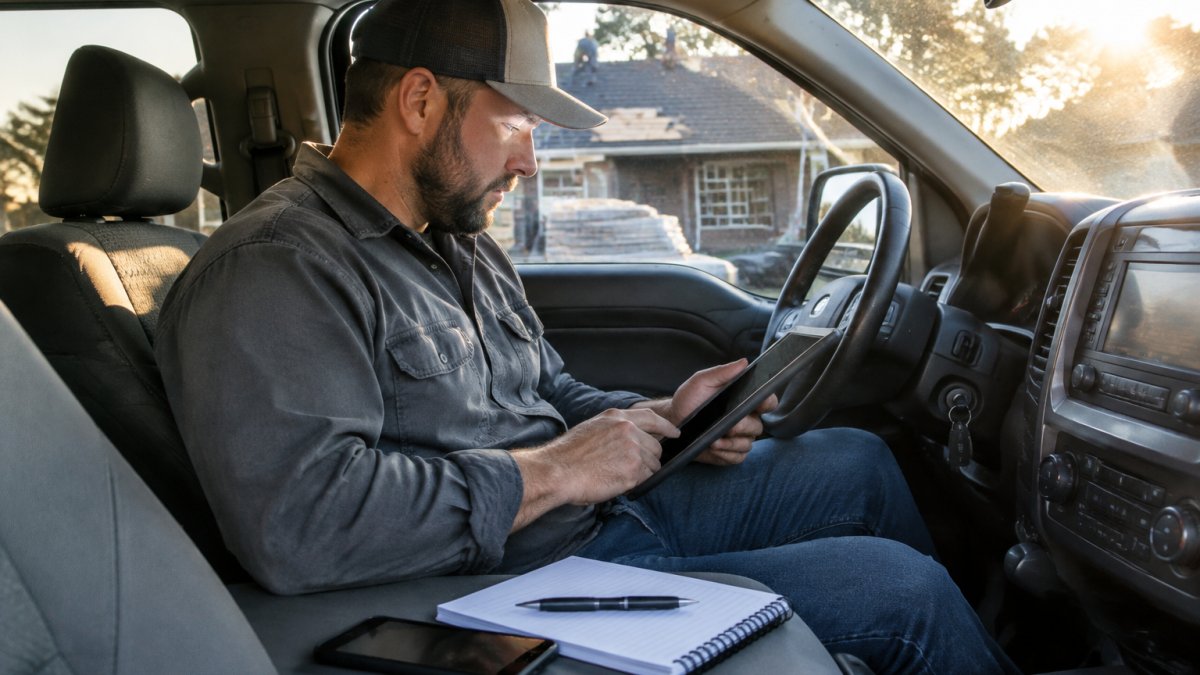
Most lost jobs die in follow-up, not in pricing. A repeatable workflow fixes that, but only if every lead goes through the same steps, in the same order, with the same questions. Here is the workflow we recommend, with the specifics most contractors skip.
Step 1: Respond Within One Hour
Speed is the single biggest lever. A homeowner who called three roofers usually books the first one who answers or calls back. Set a rule: every new lead gets a call or text within 60 minutes during business hours, and within the first hour of the next business day otherwise.
- Call first. If no answer, send a short text: your name, company, and a one-line offer to schedule a free inspection.
- Log the attempt and the time in your lead system immediately.
- If you cannot answer live, use a shared inbox or answering service that logs the lead, not a voicemail box nobody checks.
Watch out: the most common failure is buying more leads before fixing response time. You end up paying twice for the same lost job.
Step 2: Qualify With Three Questions
Qualification is not an interrogation. Three questions tell you whether to book an inspection now or nurture the lead:
- What is the roof doing?, leak, missing shingles, age, storm damage, or full replacement planning. This tells you urgency and job type.
- How old is the roof, and has it been repaired before?, age and repair history predict whether the homeowner is shopping for a repair or a replacement.
- What is your timeline and budget range?, a homeowner planning for next spring is a nurture lead, not a this-week appointment.
Based on the answers, route the lead into one of three buckets: book now (active leak or storm damage), book this month (replacement planning), or nurture (no timeline or budget yet). Do not discard nurture leads, they are the cheapest jobs you will ever win if you stay in touch.
Step 3: Book the Inspection Before You Hang Up
Never end a qualification call with "I'll send you some times." Offer two specific windows and confirm one. Send a calendar invite or text confirmation with the address, the inspector's name, and what the homeowner should expect. A confirmed appointment is worth far more than a promised callback.
Step 4: Send the Quote Within 48 Hours
A homeowner comparing several roofers tends to favor whoever sends a clear, professional quote first. Include line-item detail, photos from the inspection, your timeline, and a clear next step. If the job needs a second visit or an adjuster, say so in the quote so the homeowner is not left guessing.
Step 5: Run a Three-Touch Follow-Up Sequence
Most contractors follow up once and quit. A simple sequence recovers a meaningful share of quiet leads:
- Day 2: call, then text if no answer, "Just checking you got the quote; happy to walk through it."
- Day 5: call and email, ask if they have questions or want to compare options.
- Day 12: final call and a written note, leave the door open without pressure.
After day 12, move the lead to nurture. Add it to a monthly check-in list so you are the contractor who is still around when the homeowner is ready.
Track Every Lead by Stage
Use five stages: new, contacted, quoted, won, lost. Every lead sits in exactly one stage, and every stage has a next action and a date. If a lead sits in "quoted" for more than a week with no next step, it is already cold. Review the board every morning and clear overdue tasks before making new calls.
Nurture the Leads That Are Not Ready
A homeowner planning a replacement next spring is not a lost lead. Keep them warm with a quarterly check-in, a seasonal roof-maintenance reminder, and a note when you are working in their neighborhood. A simple nurture list can keep quiet leads from disappearing for good.
For a tool built around making that sequence repeatable, see the quote follow-up software.
Vetting Lead Providers and Protecting Your Data
Lead providers vary wildly. Before you sign anything, run these checks:
- Is the lead exclusive to you or shared with others?
- How are duplicate leads handled?
- What's the replacement policy for bad contact info?
Lead verification and lead scrubbing matter.
Read the contract for auto-renewal clauses. Some providers lock you in for months. Others charge for leads that never answer the phone.
Data protection is your responsibility too. Keep homeowner details in a system you control, not scattered across texts and notebooks.
If you're weighing tools and want a straight comparison of options, compare roofing software alternatives.
Start Your Free Trial and Put Every Lead on the Board
Leads don't close themselves. Someone has to answer, quote, and follow up, every single time.
That's the whole game. The contractors who win aren't the ones with the biggest marketing budget.
Roof Hammer includes a public lead capture form with spam protection, one-step lead-to-quote conversion, AI-assisted follow-up drafting, and a Today view for overdue tasks.
You can see current plans and start a free trial by visiting Roof Hammer pricing.
Frequently Asked Questions
How much does it cost to get roofing leads?
Cost depends on the channel. Free roofing leads from referrals, reviews, and neighborhood prospecting cost your time rather than cash. Paid marketplaces and paid search charge per lead or per click, and pricing and conversion vary by provider and lead type. Rather than chasing a single benchmark, track your own cost per booked estimate for each channel over 60 to 90 days. That number tells you which sources are worth scaling and which are quietly eating your marketing budget.
How can roofing contractors qualify a lead before preparing an estimate?
Ask four questions before you invest time in a quote: Is the property owner the decision-maker? What is the roof age and material? Is this an insurance claim or a cash job? What timeline are they working to? A roofing lead capture form can collect most of this up front, and a follow-up call confirms the rest. Leads that answer all four clearly deserve a full line-item estimate; the rest go into a nurture sequence so you are not drafting quotes for tire-kickers.
Are paid roofing leads worth it compared with free roofing leads?
Paid leads buy speed: you get a homeowner in front of you today instead of building visibility for months. They are worth it when your close rate and average job value cover the lead cost, and when you can respond within minutes. Free roofing leads from referrals and past customers convert better but arrive unpredictably. Most healthy roofing businesses run both: paid sources to fill the pipeline now, and a referral and review habit that lowers customer acquisition cost over time.
How do roofing contractors get leads from insurance companies?
Insurers do not hand contractors a lead list. Work comes from homeowners filing storm damage claims and choosing an approved or recommended roofer. Your job is to be visible when that happens: collect before-and-after photos, document storm damage thoroughly during roof inspections, help homeowners understand the claims process, and ask satisfied insurance-claim customers for reviews. A roofing lead follow-up routine that checks in during the claim keeps you top of mind when the adjuster approves the work.
The challenge is simple: pick one channel this week, fix your response time, and track every lead to a quote. Get started with Roof Hammer and turn quiet leads into booked jobs.
