blog
Roofing Software for Solo Contractors: What Fits One Person
Quick Summary
Roofing software for solo contractors is worth evaluating once a spreadsheet starts costing you jobs through slow follow-ups. A focused tool keeps every open quote in one list, shows what is due today, and handles the quote and follow-up without extra office hours.
- Losing even one job a month to slow follow-up is a sign a dedicated tool is worth evaluating.
- Check whether free plans limit open quotes, allow data export, and include follow-up reminders.
- Time one real quote from measurement to sent document during each tool's trial.
- Confirm the waste factor can be set per job type, not as one global percentage.
- Export one customer and one quote during the trial to confirm the data is readable.
Table of Contents
- Why a Solo Roofer Needs More Than a Spreadsheet
- Free Roofing Software for Solo Contractors: What the Free Plans Actually Cover
- Best Roofing Estimating Software for Measurements, Materials and Quotes
- Roofing CRM Software: Lead Capture, Follow-Ups and the Today View
- Roofing Quote Software: From Lead to Paid Invoice in One Workflow
- Total Cost of Ownership, Data Portability and Cancellation Risks
- Choosing Your Setup and Starting a Free Trial This Week
- Frequently Asked Questions
Why a Solo Roofer Needs More Than a Spreadsheet
Last Updated: November 7, 2026
Most solo roofers start with a spreadsheet, and that works until it doesn't. A quote lives in one tab, the photos sit in a phone camera roll, and the follow-up reminder lives in your head. Roof Hammer was built for exactly that gap, and the question for a one-person shop is whether roofing software for solo contractors is overkill or simply overdue.
Here's our take: if you're losing even one job a month to a slow follow-up, a dedicated tool is likely worth evaluating.
The real problem with spreadsheets isn't the math. It's memory. A quote sent on Tuesday needs a nudge on Friday, and a homeowner who got three quotes will usually sign with whoever replied first. Dedicated software keeps every open quote in one list and tells you what's due today.
Solo doesn't mean simple, either. You're estimating, selling, ordering materials and chasing invoices, often in the same afternoon. A tool that handles the quote and the follow-up frees your hands for the roof.
Watch out: a spreadsheet feels free, but it quietly charges you in missed follow-ups and rework every week.
Free Roofing Software for Solo Contractors: What the Free Plans Actually Cover
Free plans sound ideal for a solo operator, and they can be useful for testing a workflow. The catch is what they limit, so check the terms before you rely on one.
Before you commit, check three things: how many quotes the free version allows at once, whether you can export your data, and whether follow-up reminders are included or locked behind a paid plan. Those three answers tell you more than the price tag does.
Roof Hammer offers a free trial and a free plan, so you can test the quote workflow with your own jobs before you pay. We'd suggest running one real quote from start to finish during the trial and comparing the time it takes against your current method.
Best Roofing Estimating Software for Measurements, Materials and Quotes
Estimating is where solo roofers feel the most friction. You measure the roof, calculate squares, work out material quantities, then turn all of it into a quote the homeowner can actually read. Other resources on this topic often focus on feature lists. The practical question for a one-person shop is narrower: which estimating approach gets a finished, accurate quote to the homeowner fastest without adding office hours to your day? See how roofing estimating alternatives compare on that measure.
Start by separating the three jobs estimating software does, because no single tool is best at all three.
Measurement capture. You can measure by hand and enter dimensions, order an aerial measurement report, or use a tool that stores photos and field notes alongside the numbers. Aerial reports can be quick for standard residential roofs but may not capture complex geometry. Hand measurement takes longer but gives you direct control over unusual roofs.
Material calculation. Estimating software can convert measurements into squares and material quantities, and the waste factor is an important input to check. Confirm whether any tool you consider lets you set waste per job type rather than one global percentage.
Quote presentation. The estimate has to become a document the homeowner can read without a design degree. That means line items grouped by trade or phase, clear quantities, and a total that matches what you will actually order. A quote that looks professional but does not reconcile to your material order creates rework later.
Roof Hammer lets you build quotes from fields and photos in one step, so the measurement and the customer-facing document can stay together. That can matter for solo contractors who quote the same job types repeatedly.
Other providers take different approaches to measurement and material calculation. Compare them on how quickly a finished quote reaches a homeowner, not just on feature lists. A useful test is to time yourself building one real quote from measurement to sent document in each tool's trial.
Best for: solo contractors who quote the same job types repeatedly and want consistent, fast quotes.
Skip if: you need detailed takeoffs for large commercial roofs, which call for specialized measurement tools and often a dedicated estimator.
Watch out: a tool that calculates materials automatically can still be wrong if your waste factor or pitch assumptions are off. Always spot-check the material list against your own experience on the first few jobs.
The article breaks estimating into three jobs, and the table below summarises how each one is handled and where it can go wrong.
| Estimating job | What to check | Watch out for |
|---|---|---|
| Measurement capture | Hand entry, aerial report, or stored photos | Aerial reports may miss complex geometry |
| Material calculation | Squares and quantities from measurements | Waste factor and pitch assumptions |
| Quote presentation | Line items grouped by trade or phase | Quote must reconcile to your material order |
| Best for | Solo contractors quoting repeat job types | Consistent, fast quotes |
| Skip if | Large commercial roofs needing takeoffs | Specialized tools and a dedicated estimator |
Roofing CRM Software: Lead Capture, Follow-Ups and the Today View
A CRM for a solo roofer doesn't need forty modules. It needs to catch every lead, show every open quote, and remind you what to do next. That's the job of a focused tool.
Roof Hammer includes a public lead capture form with spam protection, so inquiries from your website land in one queue. The incoming request queue also matches existing customers. The Today view shows overdue tasks and new leads together.
The AI-assisted follow-up drafting helps you draft personalized follow-up messages instead of generic templates.
Watch out: a follow-up list you never look at is worse than no list. Set the Today view as your first screen of the day.
Roofing Quote Software: From Lead to Paid Invoice in One Workflow
Here's where a practical workflow matters most. A complete path looks like this: a lead arrives through your form, you convert it to a quote in one step, you add photos and measurements, the homeowner accepts, and you invoice and collect payment.
Many tools cover the first half of this path. The second half, from accepted quote to paid invoice, is where solo contractors often switch between apps. Before you choose a tool, walk through this full path with a sample job and count the steps.
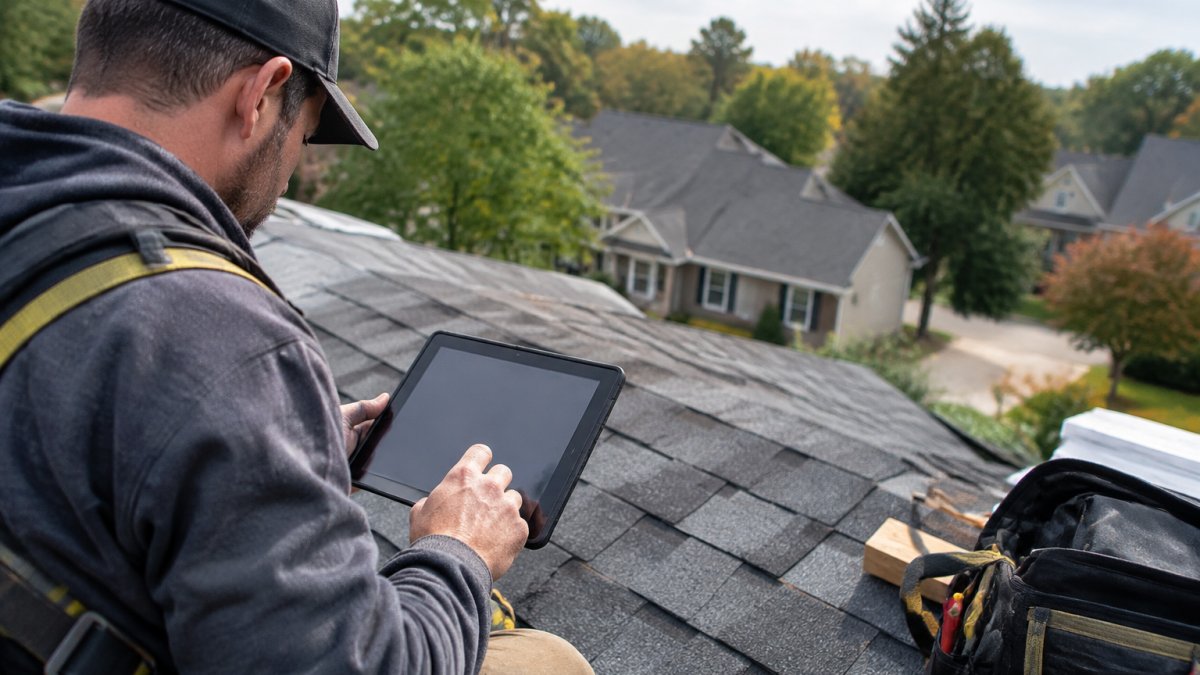
A roofer in work clothes reviewing a quote on a tablet, with a roof photo on screen, captures the moment this workflow runs in real life, parked outside the job site.

Total Cost of Ownership, Data Portability and Cancellation Risks
The sticker price is only part of what you pay. A realistic cost picture should also account for the time spent answering calls while you’re on a roof, since a roofing answering service can affect both your workload and your monthly expenses.
Build your own estimate from five cost buckets, because published plan prices rarely tell the whole story.
Subscription or plan fee. This is the advertised number, but check what it counts. Some tools price per user, others per active job, quote, or measurement report.
Per-report or per-measurement charges. Aerial measurement reports are often billed individually or bundled into a credit pack. If you quote ten roofs a month and each report carries a separate charge, that line item can exceed the subscription itself.
Payment processing fees. If the tool collects deposits or final payments, card processing fees apply on top of the subscription. A common pattern is a percentage plus a fixed per-transaction fee, and the exact rate depends on your processor and card type.
Onboarding and learning curve. Your time has a cost. A tool that takes a week to learn is not free just because the plan is cheap. Use a consistent test: set up your lead form, build one real quote, and send one follow-up.
Add-ons and integrations. Scheduling, e-signature, accounting sync, and customer messaging are sometimes separate modules. List the ones you actually need and price them before you commit.
Add those five buckets and you have a realistic monthly figure. Compare that figure to the value of one recovered job, not to a competitor's headline price.
Data portability deserves equal weight. Before you sign up, ask three questions. Can you export your customer and quote records in a usable format, such as CSV or PDF? What happens to open quotes, photos, and job history if you cancel?
Run a small export test during the trial. Export one customer and one quote, open the files, and confirm the data is readable outside the tool.
Roof Hammer publishes its plans on its pricing page, so you can compare them directly. For current pricing and a quote on your specific volume, check the Roof Hammer pricing page, since prices can change and depend on your setup.
Compare the total picture, not one line item. A tool that exports your data cleanly can be worth more to you than one with a slightly lower monthly fee. If you're weighing a specific competitor, see how a quote-based alternative compares on cost and exit terms.
Watch out: free plans and trials sometimes restrict export or delete data after a set period. Confirm the export and retention terms before you enter real customer records.
Choosing Your Setup and Starting a Free Trial This Week
Start with the workflow that hurts most. If follow-ups are the problem, test the Today view first. If quoting takes too long, build one quote from start to finish and time it.
Use the free trial to run real work, not a demo. Set up your lead form, send one live quote, and log one follow-up. At the end of the trial, you'll know whether the tool fits how you actually work.
Once you know your volume, compare the Roof Hammer plans on the pricing page to see which fits your needs.
A simple next step is to pick one job you quoted last month, rebuild it in the trial, and see how long it takes.
Frequently Asked Questions
Is there free roofing software for solo contractors?
Yes, several providers offer a free plan or free trial, but the limits matter more than the price tag. Check how many leads, quotes or users the free tier allows, whether you can export your data, and whether follow-up reminders are included. Roof Hammer offers a free plan and a free trial, so you can test lead capture and quote generation on real jobs before deciding. For current plan details and limits, see the Roof Hammer pricing page.
What is the best roofing estimating software for a one-person business?
The best estimating software for a solo roofer is the one that turns your measurements and photos into a clean quote quickly, without forcing you into features you will never use. Look for photo attachments, room or roof-area fields, a repeatable quote template and the ability to send the quote to the homeowner in a few taps. Test it by building one real quote from start to finish and timing it against your current spreadsheet method.
Do solo roofing contractors need a CRM?
A solo roofer can run on a spreadsheet for a while, but once you have more than a handful of open quotes, a CRM becomes useful for one reason: it tells you who to follow up with today. A roofing CRM tracks lead status, quote history and overdue tasks in one place. If you regularly lose track of follow-ups or quotes sit unanswered for days, a lightweight CRM may be worth considering.
How much does roofing software cost for a one-person business?
Pricing varies by provider and by plan tier, and many vendors change their rates, so check each provider's website for current figures. When comparing, calculate the total cost over twelve months, including setup time, add-on modules and any per-user fees. For Roof Hammer, current pricing is listed on the pricing page, and a free trial lets you confirm the fit before you pay.
